What is a Cylinder Key?
The key behind most modern front doors
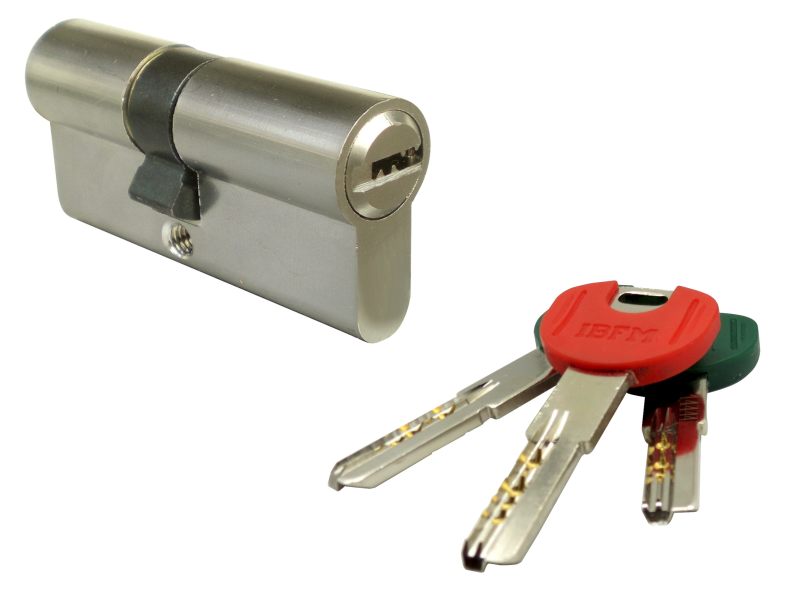
A cylinder lock is the small barrel that sits inside a door lock. You put the key in the front, and the cylinder decides whether the lock's bolt is allowed to move. The key is a flat metal blade with a row of cuts along its edge, known as the 'bitting'.
In the UK the most common shape is the Euro profile cylinder, found in uPVC, composite and aluminium doors, many timber doors fitted with euro mortice locks, and commercial doors. Oval and rim cylinders turn up on older doors and night latches. Almost all of them use a pin-tumbler mechanism.
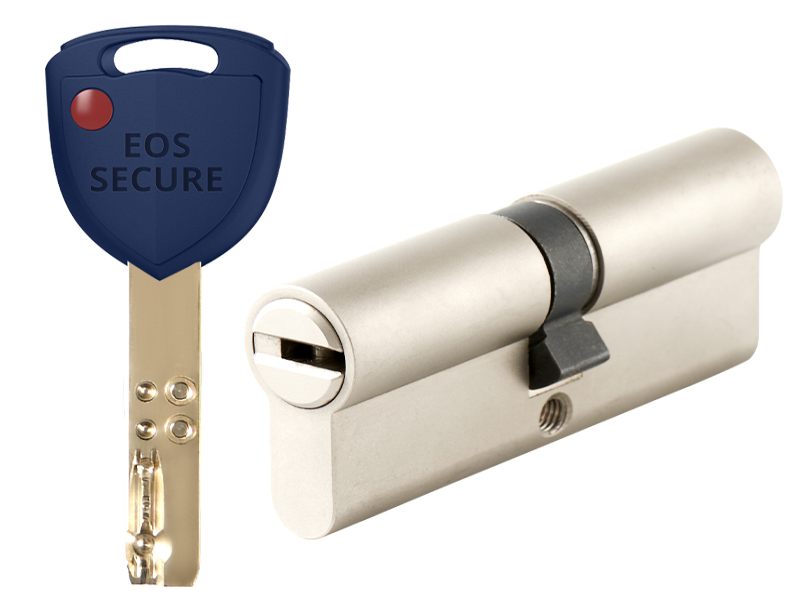
'High-security' cylinders add hardened parts, extra security pins, restricted keyways and key-control cards, and the best are independently tested to standards such as TS 007 and Sold Secure.
Cylinder Key at a glance
- Typical security: Standard to very high (depends on the cylinder)
- Mechanism: Pin tumbler
- Common shape: Euro profile (also oval and rim)
- Typical pins: 5 or 6
- Key: Flat blade with cuts along the edge
- Sizing: Measured in mm either side of the central fixing screw (for example 35/35)
- Copied on: Standard or high-security duplicating machine
Inside the lock
How does it work?
Pins stand in the way
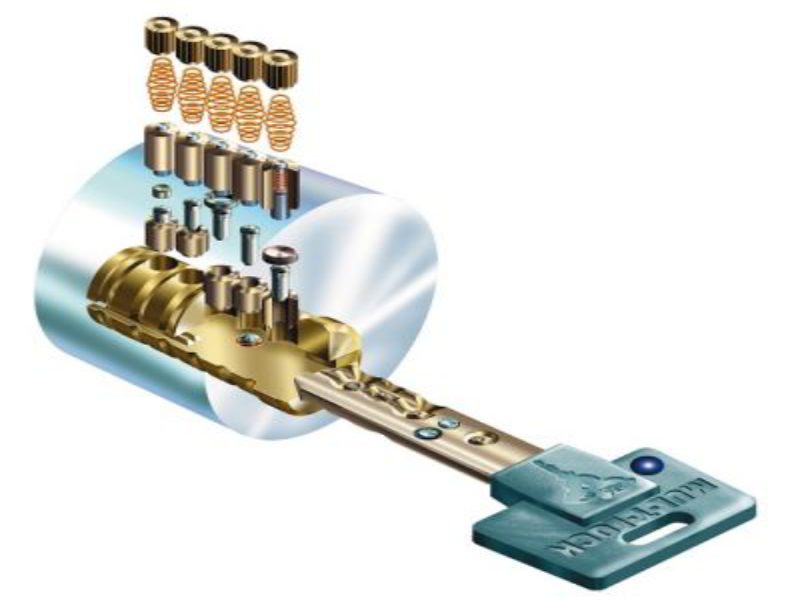
Inside the cylinder are stacks of small pins - a key pin below and a driver pin above - pushed down by springs across the gap between the turning plug and the fixed housing. While those pins straddle the gap, the plug cannot turn.
The key lifts each stack
As the right key slides in, each cut lifts its pin stack to exactly the right height so that the join between the pins lines up with the gap. This line is called the shear line.
The plug turns
With every pin aligned, the plug is free to rotate and a cam at the back of the cylinder moves the lock's bolt.
Extra protection in better cylinders
Higher-grade cylinders use specially shaped pins (such as spool and serrated pins), hardened inserts that resist drilling, and a sacrificial break-line so that, even if the outer part is snapped off, the part that works the lock stays out of reach.
In the workshop
How is a cylinder key cut?
Most cylinder keys can be copied quickly on a duplicating machine. The important part is getting the right blank and a clean, accurate cut.
Identify the key and blank
Cylinder keys come in many profiles (keyway shapes). We match your key to the correct blank, because the wrong one will not enter the lock or turn smoothly.
Trace and cut
On a duplicating machine the original and the blank are clamped side by side. A tracer follows the cuts on the original while a cutter shapes the blank to match. The new key is then smoothed (deburred) and tested.
Cut by code
If the original is lost, a key can be cut from its code, which may be stamped on the key, on the cylinder or on a security card, using a code-cutting machine, or made by working from the lock itself.
Key-controlled systems
Some high-security cylinders are 'key controlled': copies are only made when the registered owner presents the security card, so keys cannot be duplicated casually.
Uses
Where you will find it
uPVC, composite and aluminium front and back doors
Timber doors fitted with euro mortice locks
Commercial and communal doors
Padlocks, cabinets and lockers
Master-key systems in offices, shared houses and student accommodation
The honest picture
Good to know
Strengths
- Easy to replace, resize or re-key without changing the whole lock
- Available in a huge range of security levels, up to TS 007 3-Star and Sold Secure Diamond
- Master-key suites are possible for buildings with many doors
- Keys are small, light and quick to copy
Worth knowing
- Basic cylinders can be picked, bumped, drilled or snapped; for an external door choose a tested anti-snap cylinder
- A cylinder is only as strong as the lock and door furniture around it
- A cylinder that sticks out beyond the handle plate is easier to attack, so the correct length matters; we can check the fit
Standards to look for
- TS 007 (1, 2 and 3 Star): tests resistance to picking, drilling, bumping, snapping and plug extraction. A 3-Star rating is recommended for external doors
- Sold Secure SS312 Diamond: an independent test scheme for high-security cylinders
- BS EN 1303: the European standard that grades cylinders for locks
Gallery
Cylinder Key in pictures
F.A.Q
Frequently asked questions
-
How do I know which cylinder I have?
Bring the key, or the cylinder itself, and we can identify the profile, measure the size and match the blank.
-
Can any cylinder key be copied?
Standard keys are easy to duplicate. Restricted or patented key systems need the registered owner's security card, which is how they keep their keys under control.
-
What does 3 Star mean?
It is the top rating in the TS 007 test, which attacks the cylinder in five ways: picking, drilling, bumping, snapping and plug extraction. It is the rating recommended for external doors.
-
My key has become stiff. What should I do?
Do not force it. A worn key or a dirty cylinder is the usual cause. A fresh cut made from your original key (not from a worn copy) and a little dry lubricant such as graphite or PTFE spray often cures it. Avoid oil, which attracts dirt.
Quote
Request a quote for a Cylinder Key
Location:
Keys Master, 159 Queens Road, Peckham, London SE15 2ND
Email:
Call:
Keep exploring
Other keys