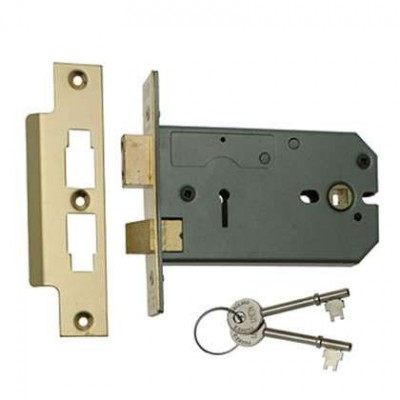
What is a Mortice Key?
Strong, traditional lever locks for the doors that matter
A mortice lock is fitted into a slot (the mortice) cut into the edge of the door, rather than being screwed to its surface. The lock body is hidden, which keeps the door looking tidy and lets the lock be larger and stronger than a surface-mounted one.
The key for a traditional mortice lock is a lever key: a flat steel key whose end, the 'bit', has cuts of different depths. It is very different from the pin-tumbler key used in a cylinder lock.
There are two main types. A sashlock has a handle-operated latch as well as a key-operated deadbolt, which is typical for a front door. A deadlock has only the deadbolt and is used as an extra lock, or on gates, outbuildings and some internal doors.
Mortice Key at a glance
- Typical security: Standard to high (BS 3621 5-lever)
- Mechanism: Lever tumbler
- Fitted: Inside the edge of the door
- Types: Sashlock (latch and deadbolt) and deadlock
- Common levers: 3 for internal doors, 5 for external doors
- Common case sizes: 2.5 in (64 mm) and 3 in (76 mm)
- Copied on: Key machine with the correct blank
Inside the lock
How does it work?
Levers hold the bolt
Inside the lock case is a stack of flat metal levers, each pushed down by a spring. Each lever has a notch called a gate. A small stump on the bolt rests against the levers and, while they are down, it cannot move.
The key lifts the levers
As the key turns, every cut on its bit lifts its lever to a precise height. When all of them are lifted correctly, all the gates line up with the stump.
The bolt slides
With the gates aligned, the key can throw the bolt out (lock) or draw it back (unlock). A BS 3621 lock throws its bolt 20 mm into the door frame.
More levers, more combinations
A 3-lever lock suits internal doors. A 5-lever lock offers many more possible key combinations and extra resistance, and good ones add anti-pick and anti-drill features.
In the workshop
How is a mortice key cut?
Mortice keys are cut with the same careful clamp-and-trace method as other keys, but the cuts have to be very accurate because each one must lift a lever to exactly the right height.
Match the lock and key
Mortice keys come in many shapes, with different bows, shanks and bits. We identify the lock maker and the number of levers so that the right blank is used.
Cut the bit
The original and the blank are clamped in the machine and the cutter reproduces each cut on the bit at its exact depth and position.
Test and adjust
The key is tried in the lock and fine-tuned until it turns smoothly without force.
If the key is lost
A locksmith can often create a replacement by working from the lock itself. Otherwise the lock can be replaced with a new one to the same standard.
Uses
Where you will find it
Timber front and back doors
Garden gates, sheds and outbuildings (deadlocks)
Period and listed properties where the original look matters
Internal doors (3-lever)
Commercial premises
The honest picture
Good to know
Strengths
- A strong steel deadbolt hidden inside the door
- A long, trusted track record in UK homes
- 5-lever BS 3621 locks are commonly specified by home insurers
- No electronics and no batteries
Worth knowing
- Only suitable for doors thick enough to be morticed, usually timber
- A 3-lever lock gives only basic security
- A badly fitted mortice weakens the door, so correct fitting matters
- Keys are longer and heavier than cylinder keys
Standards to look for
- BS 3621: the British Standard for thief-resistant mortice locks. Insurers often ask for it on external doors, so check your policy
- BS 3621 locks are normally 5-lever (or use a cylinder), with a 20 mm deadbolt throw plus anti-drill and anti-saw features
- Look for 'BS 3621' and the Kitemark on the lock's faceplate
Gallery
Mortice Key in pictures
F.A.Q
Frequently asked questions
-
What is the difference between a sashlock and a deadlock?
A sashlock has both a latch (worked by the handle) and a deadbolt (worked by the key). A deadlock has only a deadbolt, so it is used as an additional lock or on doors that do not need a handle.
-
How do I know if my lock is BS 3621?
Open the door and look at the metal plate on its edge, the faceplate. A BS 3621 lock is normally marked 'BS 3621' and carries the Kitemark.
-
Can my mortice key be copied?
In most cases yes, as long as the correct blank is available. For the best result bring the original key rather than a worn copy.
-
My key does not turn smoothly. Why?
A worn key, a bent bit or a dry lock are the usual causes. Do not force it; a fresh cut from the original key often cures it.
Quote
Request a quote for a Mortice Key
Location:
Keys Master, 159 Queens Road, Peckham, London SE15 2ND
Email:
Call:
Keep exploring
Other keys